
Talk to anyone hiring in digital assets right now and you will hear three topics. Stablecoins. Tokenisation. Prediction markets.
That is it. Everything else has faded into background noise, at least as far as talent is concerned. The candidates want in on these three. The clients are building in these three. Capital is flowing to these three.
This week I want to talk about the third one. Prediction markets. Specifically Kalshi, and the question everyone keeps dancing around.
Is it a bookie, or is it something new?
The oracle defence
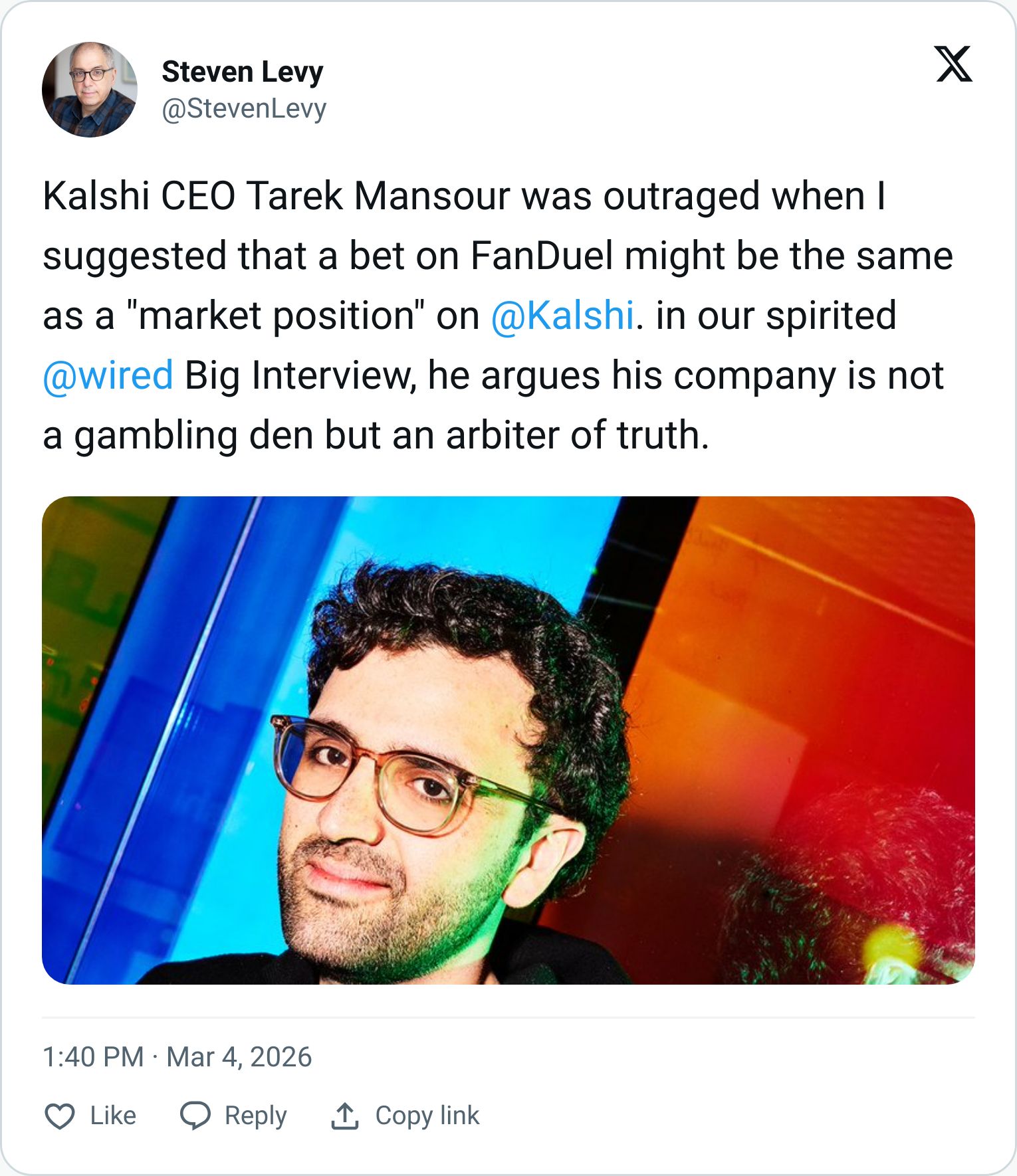
Tarek Mansour does not like the gambling comparison. When journalists put it to him that a position on Kalshi looks a lot like a bet on FanDuel, he pushes back hard. His pitch is that Kalshi replaces debate and punditry with markets, accuracy and truth. Not a bookmaker. An oracle you can audit.
He has a structural argument, and it is not nothing. A sportsbook is the house. It profits when you lose. Kalshi is a peer-to-peer exchange. Customers trade against each other, Kalshi clips fees from both sides, and the platform has no stake in the outcome. That is a financial market, not a casino.
The numbers say the market believes him. Kalshi raised at a $22 billion valuation this year. Roughly 2 million monthly active users. Annualised revenue now running above $1.5 billion. Kalshi and Polymarket combined cleared nearly $45 billion in monthly volume in June, driven by the World Cup. In early 2024 that figure was under $100 million a month.
The uncomfortable footnote
Here is the part Mansour talks about less. Around 90 per cent of Kalshi's activity is sports. Not elections. Not inflation. Not the future of truth. Sports.
The critics have a point too. The exchange model is not new to betting. Balanced books and fees on both sides have been the operating logic of bookmaking for decades. And a compulsive bettor chasing losses on a peer-to-peer exchange is harmed the same way as one chasing losses on DraftKings. The structure changes who profits. It does not change the behaviour.
So the honest answer is that Kalshi is both. It is an exchange with a bookmaker's customer base. The regulators have noticed. The CFTC published a proposed framework in June that treats clean sports outcome contracts favourably and takes aim at everything murkier.
What the talent is telling you
You know my thesis. Talent flow is the earliest signal of any market shift. It moves before the press releases and long before the revenue.
So look at who is actually being hired.
Susquehanna built the first dedicated event contracts desk and is now the flagship market maker on Kalshi. Jump Trading doubled its team and took equity in both platforms. DRW is hiring prediction markets traders. Wintermute started quoting two-sided on both venues in June. Polymarket hired its interim US CTO from Citadel, its chief risk officer from Nasdaq, and its chief compliance officer from Robinhood. Coinbase alumni are running regulation and investigations.
That is not a sportsbook hiring pattern. Sportsbooks hire in marketing, promotions and retention. Prediction markets are hiring quants, market makers, exchange technologists and heavyweight compliance leaders.
The talent has answered the question the pundits are still debating. Whatever the product looks like today, these companies are building financial market infrastructure. That is the truth about Kalshi.
What this means for you
If you are thinking about a move into this space, three things matter.
The teams are tiny and the leverage is enormous. Kalshi runs on roughly 120 people. Polymarket planned to grow from 110 to 260 this year. At that scale every senior hire shapes the company. You will not be a cog. You will be load-bearing.
The winning profile is convergence. The candidates getting hired sit at the intersection of exchange infrastructure, quant trading and regulated markets. If you have run market structure at an exchange, built low latency systems at a trading firm, or led compliance through a regulatory fight, you are exactly what these firms cannot find enough of.
Skin in the game is the new CV. DRW's job specs explicitly favour candidates who have been trading Kalshi or Polymarket as a personal project. This is the rare sector where your P&L is your portfolio. If you want in, start trading. Understand binary contracts, terminal risk and how these books actually settle. It will show in the interview.
And if you are building in this space and trying to attract this talent, understand what you are competing against. These candidates have offers from Citadel and Jane Street. You will not win on cash alone. You win on the argument Mansour is making. Sell the mission of pricing truth, and mean it. The best quants are drawn to unsolved problems, and prediction markets are full of them.
The bookies never had that pitch. That might be the real difference.
Thank you for reading - I will write to you next Friday. Until then have a great weekend . Sam - founder, spearpoint search.
